
Trace Former Columbia County Property Owners by Era
Where you begin depends on when the transfer took place. Recent changes in ownership show up first in the statewide recorder index. Older chains take more digging through general indexes, deed books, plats, and tax digests.
Anchor the timeline with the newest deed you know. That document fixes the end point. From there, work backward transfer by transfer. Follow each parcel number and deed reference until the ownership chain runs out.
| Source | Years It Covers | Where Held | What It Shows |
|---|---|---|---|
| GSCCCA Real Estate Index | Documented locally from at least 1999 | Online and Clerk | Grantors, grantees, instruments, and citations |
| General indexes | 1799-1920 catalog range | FamilySearch catalog | Name-to-book-and-page leads |
| Deed books | 1801-1901 catalog range | Microfilm and archival images | Full conveyance language and descriptions |
| Historic tax digests | Georgia collection includes 1787-1900 | FamilySearch and archives | Annual land, owner, acreage, and value clues |
The central GSCCCA form lists a system range starting in 1990, though that does not guarantee Columbia County coverage back that far. The Clerk describes all-county transactions since at least January 1, 1999. For prior owners earlier than that, begin with the historical general index rather than paging through deed volumes at random.
Build the Columbia County Deed Timeline Backward
A backward chain is a documented sequence of transfers. It is not a list of names copied off one current parcel card. Every row must connect to the same land through its description or its citation.
| Transfer Date | Grantor to Grantee | Deed Type | Book/Page or Instrument |
|---|---|---|---|
| Newest matching date | Prior owner to current grantee | Read the indexed instrument | Record exact citation |
| Earlier acquisition | Earlier owner to that prior owner | Compare warranty, quitclaim, estate, or other deed | Follow cross-reference |
| Next earlier transfer | Repeat with the former grantee as search subject | Preserve capacity and exceptions | Verify the same tract |
Dates alone cannot join the rows. Match subdivision, unit, lot, block, acreage, land lot, district, and earlier deed or plat references to keep the timeline intact.
Search Columbia County Grantors and Grantees in Reverse
The GSCCCA name search provides Party Type, Instrument Type, County, Search Name, date fields, and display controls. Pick Columbia County. Then search the present owner as Grantee to locate an acquisition. Take that deed's grantor into the next older search as Grantee.
Handle name variants with care. The form expects last name and first name for individuals. Short names need added limits to stay workable. Search entity names exactly as recorded. Narrowing dates and instrument types cuts same-name noise. The property description remains the real test.
The official GSCCCA property search form also provides a subdivision route for participating counties.
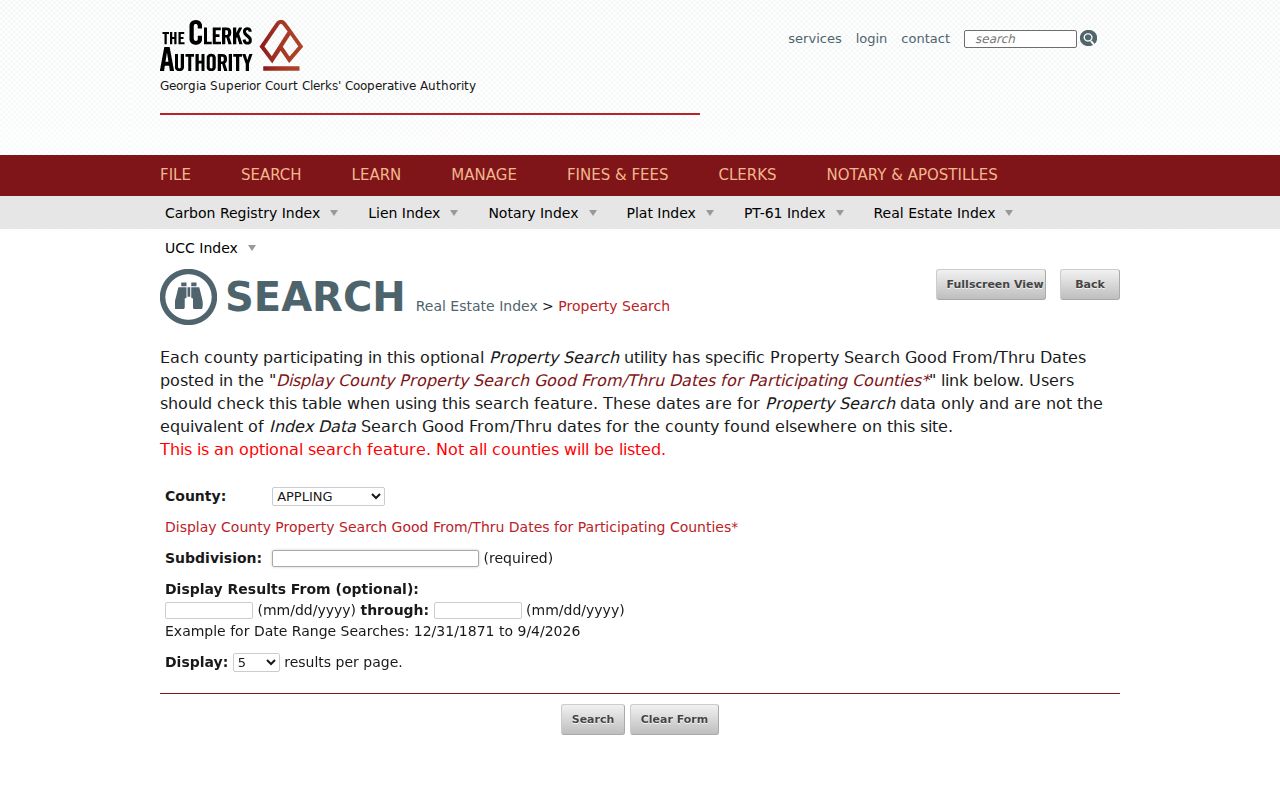
Those subdivision, date, and county choices on the official form are what support a backward chain when a street address is not the historic key.
Walk the Columbia County Deed Chain Backward
Start only after confirming the subject parcel in Maps Online and the newest plausible deed. Then repeat one controlled handoff at a time.
- Find the current party's matching acquisition as grantee.
- Read the grantor, deed date, recording date, capacity, and full legal description.
- Search that grantor as an earlier grantee and verify the same tract.
- Repeat until the online coverage ends, then carry the last book/page into the historical index.
- Grantor
- The party conveying an interest.
- Grantee
- The party receiving an interest.
- Chain of title
- The ordered sequence of instruments affecting the land.
- Reverse index
- The grantee-side route used to find how a former owner acquired the tract.
- Quitclaim and warranty deed
- Different instrument forms whose effect must be read from the deed, not guessed from the label.
Use Book and Page to Avoid Same-Name Errors
An index row or a later deed may supply a citation. Go straight to the GSCCCA book-and-page form. The form requires county, book, and page. That direct route avoids many collisions among people or companies sharing similar names.
Read the resulting image for cross-references, acreage, easements, reservations, and fiduciary language. Then check the full property description. An index row is only a finding aid. It may not carry every fact needed to prove the earlier transfer concerns the same parcel.
Note: No authenticated sample Columbia County result appears in the published materials, and no complete county-specific good-through date appears there either.
Columbia County Deed Book E Preserves a Split Date Range
The Georgia Virtual Vault holds Columbia Deed Book E as item AH 2284. Its metadata covers 1802-1803 and 1816. It also notes irregular pagination and presents a 284-image microfilm object drawn from Superior Court records.
That gap in the title is a useful warning. Never assume one filmed volume runs through consecutive years. Inspect the catalog and image metadata. Then match the historical book and page obtained from an index.
Move From the General Index to Columbia Deed Books
The FamilySearch Columbia County land catalog lists general indexes from 1799 through 1920. It also lists deed books from 1801 through 1901. Find the name in the general index first. Copy its book and page exactly. Then locate the matching film or digital image.
Search both sides of the index, because spelling and alphabetization vary. When an old address is absent, use land district, land lot, acreage, roads, creeks, neighbors, and plat references. These clues relate the old description to the present map context.
Account for Estates, Sales, and Parcel Changes
A clean buyer-to-seller sequence can break in several ways. Land may have passed through an estate, foreclosure, sheriff's sale, tax sale, court order, trustee, or gift. GSCCCA's instrument list includes these categories. When a deed points to a fiduciary or court trail, follow it.
Parcel splits, consolidations, subdivision phases, rights-of-way, and boundary agreements also change the tract being followed. Rely on the plat and each legal description. Never carry a modern parcel ID backward past the point when it existed.
Reach Older Columbia County Records Offline
Online access is not the end of the trail. The Columbia County Clerk operates from the Evans Justice Center and lists an Appling courthouse satellite on Tuesdays from 9:00 to 4:00. Confirm the location of older books before traveling.
When an existing file or export is not exposed, use the county Open Records route. Include names, party roles, address, map-and-parcel, book and page, record class, and date span. Ask for inspection, electronic delivery, or an ordinary copy as appropriate. The Act does not require the office to create a custom ownership history.
Know How Far Columbia County Former Owners Go
The paper trail in Columbia County runs deep. General indexes reach back to 1799, and deed books begin in 1801. Anything earlier may rest in Georgia headright or bounty grant material, with county deeds and plats covering the later private conveyances that followed. Historic tax digests add annual clues about an owner of record. They never substitute for the deed itself.
Columbia County reports no courthouse fire, lost-volume disaster, or wholesale destruction of its recorder holdings. So resist the urge to blame a gap on an invented catastrophe. Instead, log the last confirmed instrument, the range of deed books searched, spelling variants tried, and the archive or custodian consulted.
Coverage limit. Modern online coverage is documented from at least 1999, while older prior owners require indexes and deed books. Use former-owner records for house history, estate work, or property diligence, never to track or harass anyone.