
Columbia County Deed Types
Instrument type drives everything in Columbia County deed records. One deed conveys ownership outright. A security deed backs a loan, and a release wipes a claim off the books. The official GSCCCA list runs long: warranty deeds, quitclaim deeds, estate and foreclosure deeds, gifts, sheriff's deeds, tax-sale deeds, rights of way, and trustee's deeds, among other filings.
| Deed Type | What It Does | Common Use |
|---|---|---|
| Warranty deed | Conveys the stated real-property interest with deed warranties | A conventional sale |
| Quitclaim deed | Conveys whatever interest the grantor has without the same warranties | Family transfers or title cleanup |
| Deed from estate | Shows a fiduciary conveyance from an estate | Probate-linked transfers |
| Foreclosure or sheriff's deed | Records a transfer after a legal sale process | Foreclosure or levy research |
| Tax-sale deed | Records a conveyance tied to delinquent-tax enforcement | Tax-sale chronology |
An index row only hints at the story. Pull the recorded image to read the legal description, deed date, signatures, fiduciary capacity, reservations, exceptions, easements, and cross-references. Remember that a security deed or lien can burden land without moving title at all.
Where Columbia County Deeds Are Kept
Deeds, liens, and plats all land with the Columbia County Clerk of Superior Court. Ordinary service sits at the Evans Justice Center, 640 Ronald Reagan Drive in Evans. Mail goes to P.O. Box 2930. The clerk lists 706-312-7139 and clerkinfo@columbia.gsccca.org. A satellite office operates at the Appling Courthouse, 1958 Appling-Harlem Highway. It is open Tuesdays from 9:00 to 4:00.
Online searching runs through GSCCCA. Sometimes an image will not open. The fallback channels are a counter visit, a mail or document request, and eCertification. Check the clerk's document-request page before traveling, since office status and procedures change.
Search Columbia County Deed Fields
The GSCCCA name form separates party role from instrument type. That keeps a deed chain clean. It also filters by Columbia County, date range, neighboring counties, result size, and display format. The system notice gives an inspected-systems start of 1990. The local clerk describes transactions in all counties since at least 1999. Neither date proves when the first Columbia image actually appears.
| Field | Available choice | Why it matters |
|---|---|---|
| Party Type | Grantor, Grantee, All | Splits transfers out from transfers in |
| Instrument Type | Deeds, easements, releases, liens, court orders, and more | Removes unrelated records |
| Search Name | Last name, first name; up to 70 characters | Finds indexed parties |
| Date range | MM/DD/YYYY | Controls common-name results |
| County | Columbia, option 36 | Keeps the chain in the right recording office |
The party search requires an account login before it shows any index row, so plan on signing in for current results. The index screenshot on the property search route shows the related property form. For deed work by name, stay with the party search.
Follow Columbia County Grantors
A direct index lists grantors who transfer an interest. A reverse index lists the grantees who receive one. Start from the newest recorded deed rather than a tax-roll name, then work backward through legal descriptions and recording citations.
- Find the latest acquisition instrument by searching the likely owner as grantee.
- Match the land through subdivision, lot, district, acreage, and prior book/page references.
- Read the grantor's name, then search that party as grantee to find the earlier acquisition.
- Repeat while recording each deed date, recording date, type, parties, and citation.
- When online coverage ends, move the citation trail into the general index and deed books.
- Grantor
- The party conveying the stated interest.
- Grantee
- The party receiving that interest.
- Chain of title
- The linked sequence of conveyances affecting the same land.
- Book and page
- A recorded citation used to retrieve the instrument.
Columbia County Book and Page Search
The official book and page search asks for three things: county, book, and page. Both citation fields are required. It opens one known recording instead of a broad party list. This route sidesteps most spelling and same-name trouble.
Citations surface on assessment cards, deeds, plats, court exhibits, lien releases, and prior cross-references. Confirm the county first. A citation from another county belongs in that county's books. That rule holds even when the parcel sits near Columbia County.
Historic Columbia County Deed Books
Modern parcel IDs do not reach the beginning of Columbia County's land history. The FamilySearch catalog lists deed books from 1801 through 1901. It also lists general indexes from 1799 through 1920. Search the general index first. Copy the citation, then open the matching deed volume or film.
The Georgia Virtual Vault Deed Book E makes the point vividly. It covers 1802 to 1803 and 1816, uses irregular pagination, and holds 284 microfilm images. Those nonconsecutive dates matter. They explain why a gap should send you to the full catalog metadata. Do not jump to the conclusion that no deed exists.
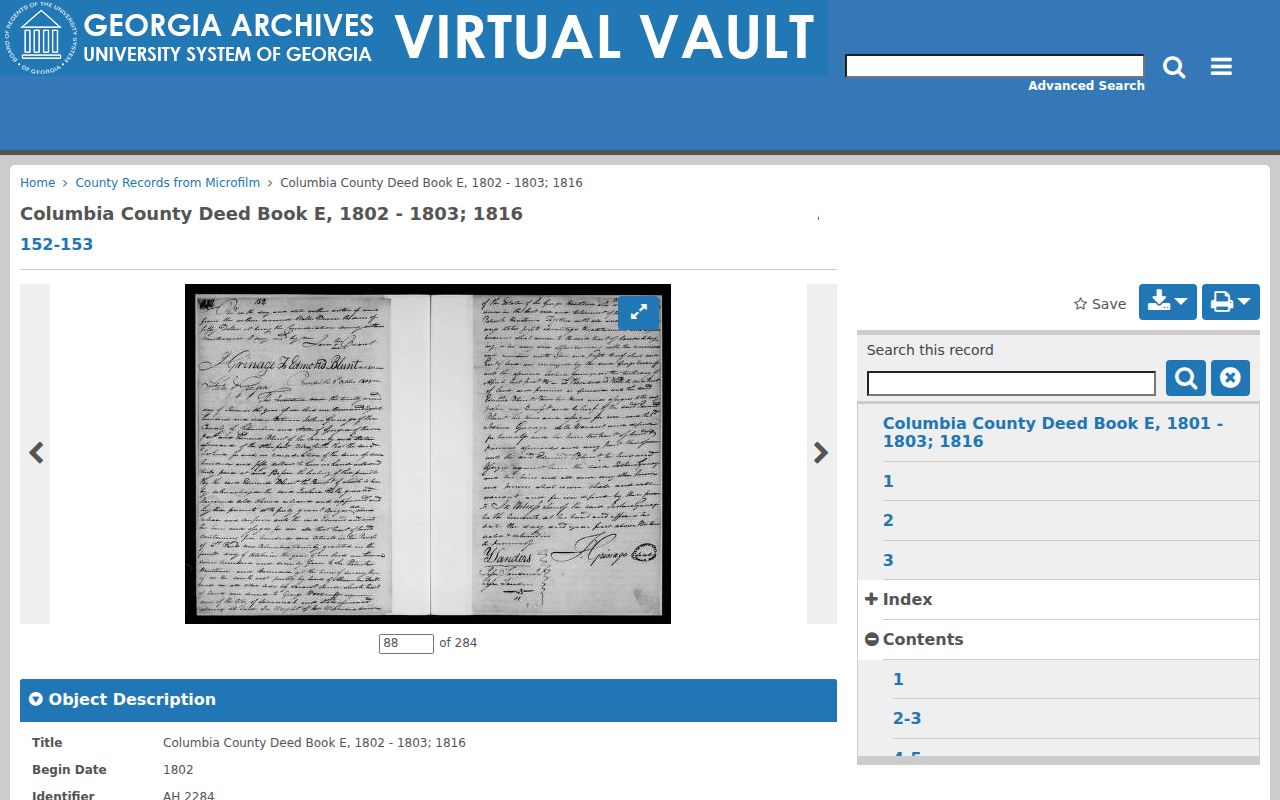
The archive image links a modern owner search to the older index-first method without pretending every historic book is online. The FamilySearch Columbia County land catalog supplies the index and deed-book film trail for earlier citations.
Its split between general indexes and deed volumes reinforces the right order: find the name citation first, then retrieve the book and page.
Columbia County Filing Alerts
GSCCCA's Filing Activity Notification System flags later index activity tied to a registration request. It launched in 2023. The service looks forward only. It depends on clerk index data, and it expires after one year under the official terms. FANS cannot rebuild past deed records or certify that no instrument exists.
The FANS terms spell out the rules governing the alert service. Treat an alert as a prompt to inspect a filing. Never treat it as a substitute for a deed chain.
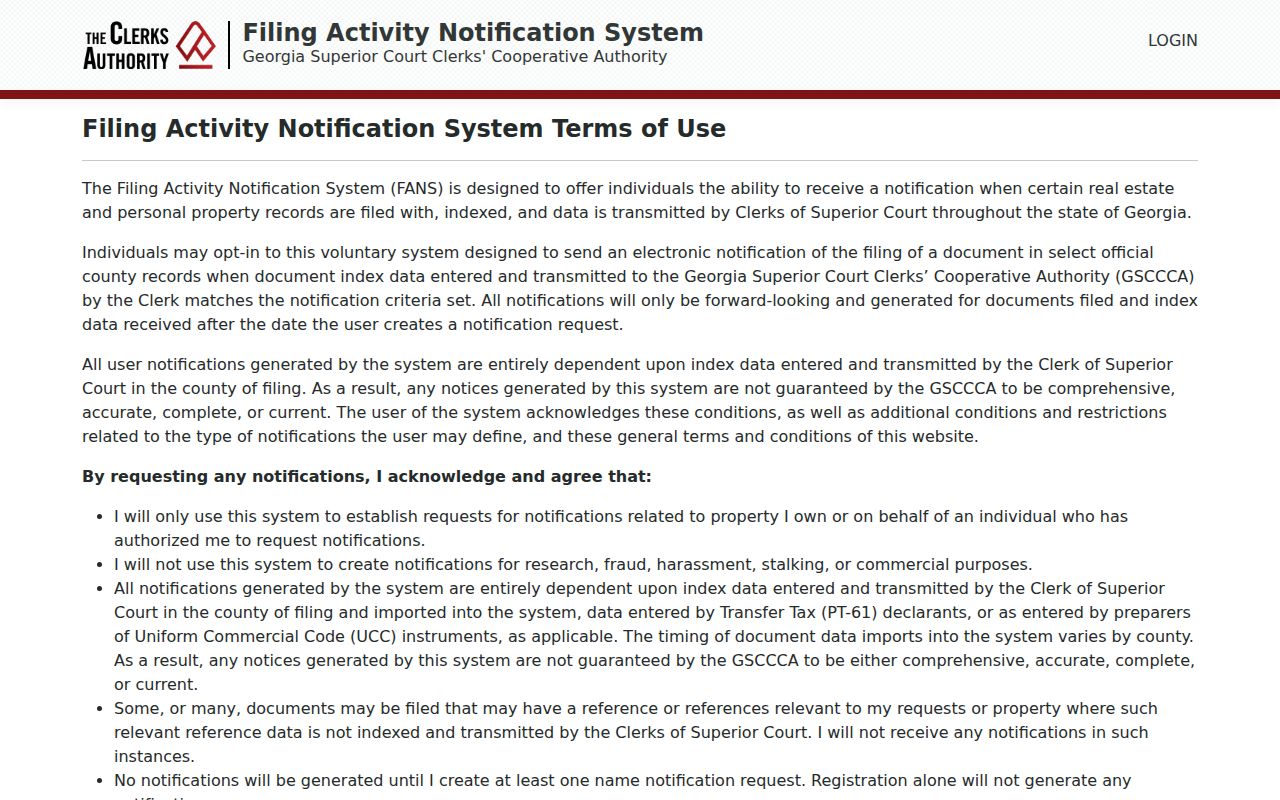
A fresh alert should always lead back to the Clerk and the GSCCCA instrument image for verification.
Order a Columbia County Deed Copy
Match the copy type to the task at hand. A plain image suits most research. The clerk prices unassisted uncertified copies at $0.50 per page, assisted copies at $1 per page, and certified copies at $2 plus $1 per page. A certificate of authority is $2. An exemplification or certification seal costs $4 plus $1 per page. Confirm the current clerk fee schedule before ordering.
Remote requests go through the document-request page and its linked eCertification service. Include party names. Add the instrument type, recording date, county, and book/page or instrument number, then state whether you need a plain image, a certified copy, or an electronic certified document.
Recorded, not guaranteed. Columbia County deed records show accepted filings. They are not a title opinion and may not reveal an unrecorded interest.
One tract often carries more than a deed. Liens, releases, security deeds, plats, and land-title court cases can all affect the same land, so search those record classes whenever the question goes beyond a single conveyance.
Cross-Check Columbia County Deed Records
A deed chain can look airtight and still be wrong. Another record class may change the answer. Security deeds and assignments reveal financing history. Releases and cancellations show when a claim was cleared. Easements and rights of way govern use rights, while liens and lis pendens flag recorded claims against the property. The Columbia clerk's land and personal-property lien docket starts January 1, 2004 and excludes UCC filings.
Land-title suits add court orders that reshape ownership. The clerk's docket landing and Georgia Courts eAccess are the official court routes. Either may require an acknowledgment or an account. When a document sits outside the portals, send the custodian a narrow request. List the parties and parcel. Add the document class, date range, and citation. Columbia County's Open Records page allows an officer up to three business days to provide access, a timetable and cost estimate, or a written explanation.
Match the deed's legal description next. Capture the county, land district or GMD, land lot, subdivision, unit, lot, block, acreage, easements, plat citation, and prior-deed cross-reference. Names shift across systems. An assessor owner string may be shortened. An LLC, trust, estate, or fiduciary can appear differently across systems, and the recorded instrument gives the fuller context.
Deed dates and recording dates serve different roles. The deed date may reflect when parties signed. The recording date places the instrument in the clerk's public sequence. A later-filed deed can describe an earlier act, and a court order or estate document may explain why the party names skip an ordinary sale pattern. Keep both dates whenever the image provides them.
Plats deserve their own check. GSCCCA's statewide plat platform began operating in 2004 for participating counties, though the clerk publishes no date for Columbia County's earliest online plat image. Search the index. Then ask the clerk for the cited plat and compare its unit, phase, lot, block, road, and easement labels against the deed. Planning approval material is not the same as the final recorded plat.
When nineteenth-century work hits a blank span, annual tax digests offer owner and land clues. Old entries lean on district, land lot, acreage, nearby roads, improvements, and tax value rather than a modern parcel number. Those clues can link one deed-book citation to the next. The deed and plat trail still controls the conveyance account.