
Read Columbia County Property Tax Records
No single office holds every figure in Columbia County property tax records. The Board of Tax Assessors values property and prepares the digest. The Tax Commissioner calculates the bill, takes payment, and pursues delinquent accounts. Before comparing two numbers, check the field label and the record year. Values, exemptions, and balances live on different schedules. A mismatch often just reflects a different source.
| Field | What It Shows | Where |
|---|---|---|
| Fair market value | The assessor's estimate of full market value | Board of Tax Assessors |
| Assessed value | The value after Georgia's assessment level is applied | Board of Tax Assessors |
| Exemptions | Approved reductions or special treatment | Assessor record and digest |
| Tax bill and status | Amount billed, paid, due, or delinquent | Tax Commissioner |
| Taxing districts | The jurisdictions used in the bill calculation | Tax Commissioner record |
Georgia assesses real property at 40 percent of fair market value, with exemptions and special programs layered on top. That ratio is not a millage rate. It also is not the bill. Exemptions trim taxable value, and levies set by local governments decide what is actually due.
Columbia County Assessor and Collector
Start with the Tax Assessor page for valuation duties, forms, and the county's qPublic system. Billing, payment, and delinquency belong to the separate Tax Commissioner. An assessed value can be right on one screen. A payment may not yet have posted on another. Save the parcel reference and tax year with every result you keep. A deed recorded after a sale closes may be newer than the annual digest. Columbia County publishes no fixed owner-update interval, so never assume a set number of days. When ownership and tax data disagree, the recording office settles it. Treat each office's files as its own record trail.
Annual Columbia County Tax Digests
Columbia County posts annual digest links covering 2015 through 2026. The official Tax Digest page states that the file is updated each year. It reflects prior-year changes. Downloads come in Microsoft Access and text-delimited formats. That makes the digest a solid source for a dated parcel list. It is not proof of current deed ownership, since deeds record on their own schedule. Read the disclaimer and file year first. Weigh any digest row against a live qPublic or deed result. The page displays the county's own downloadable property tax dataset.
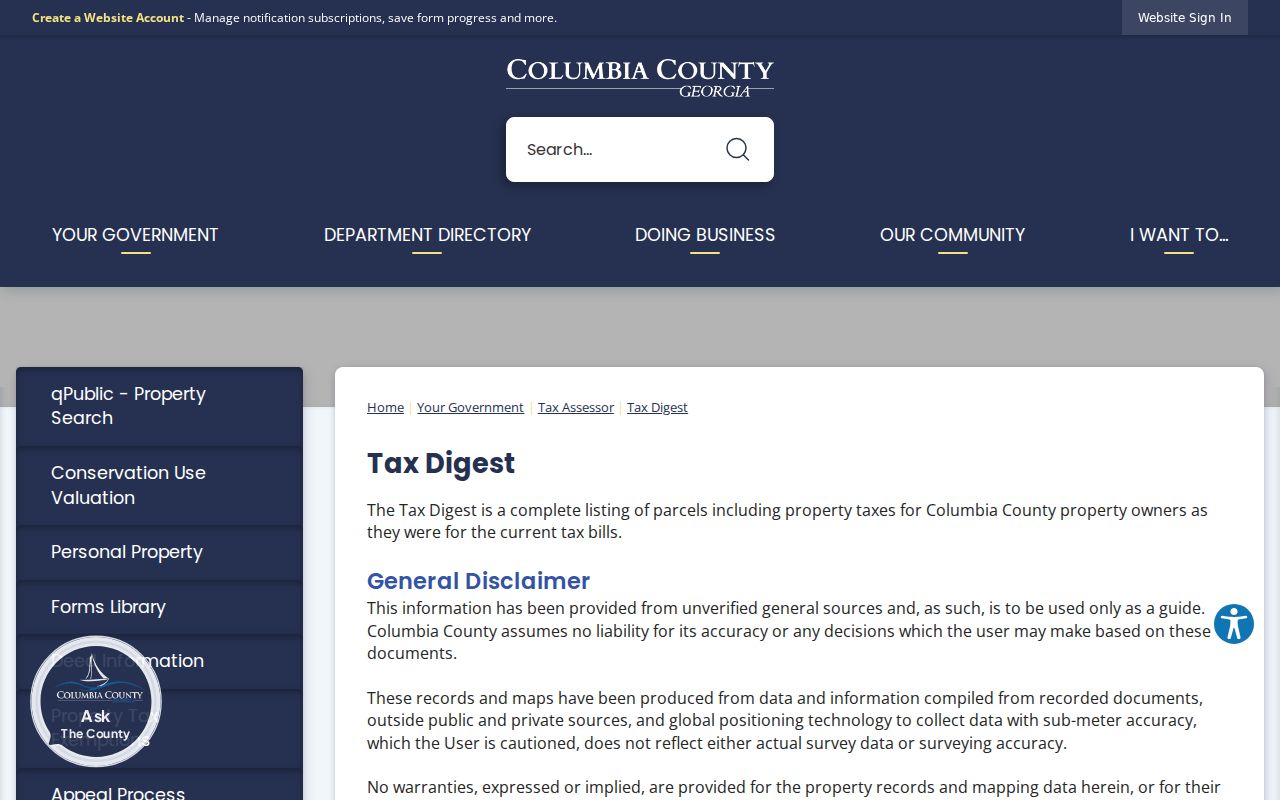
A digest row is an administrative snapshot, nothing more. Deeds, mapping changes, and bills can each post on different schedules.
Look Up a Columbia County Tax Bill
Start from the parcel, not the owner's name. Addresses get misspelled and owner strings shift over time. A map-and-parcel number gives the Tax Commissioner and the assessor one shared tract to check. Watch the tax year, too. Current and prior balances sit in separate records. Knowing which year you need saves a step.
The county's property-tax FAQ is another official route to current tax help and lookup guidance.
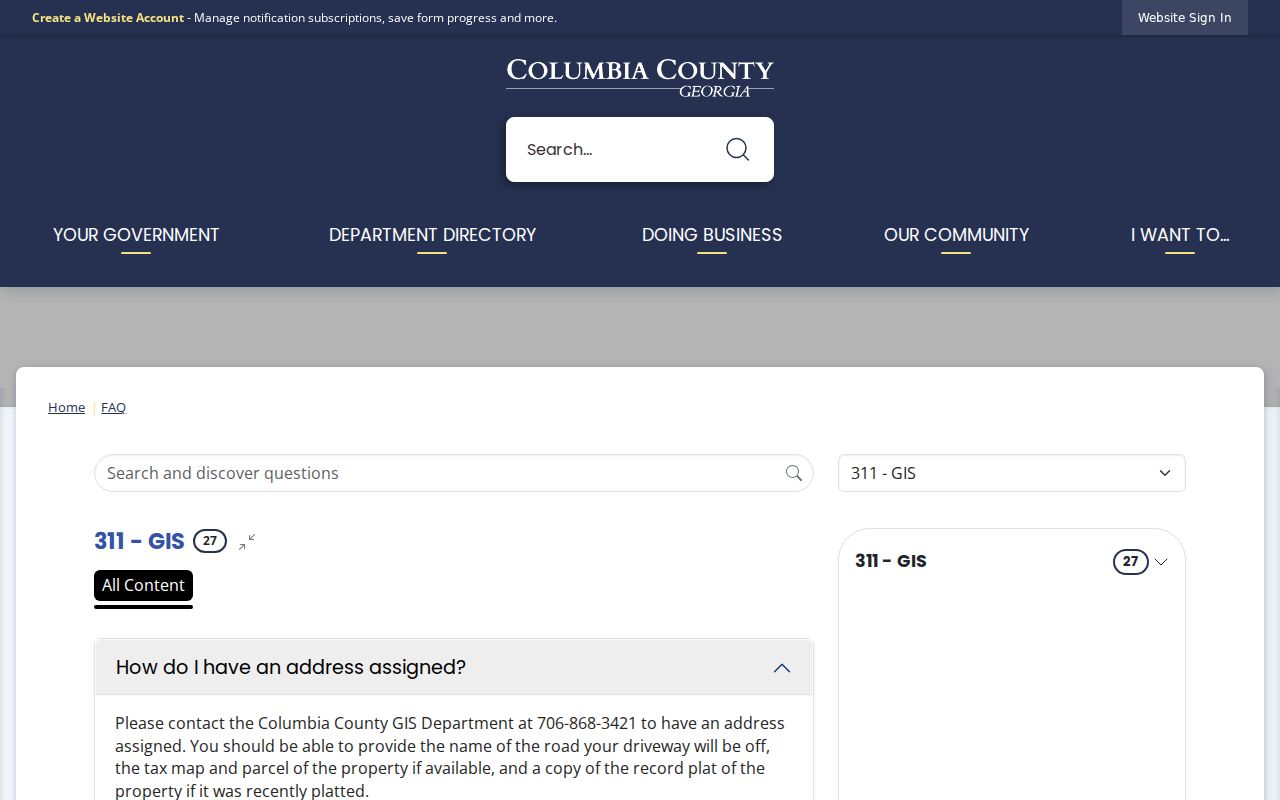
The county's payment site pairs general instructions with a specific account. Have the tax year and parcel key in hand so the right record comes up. Without them, a search can land on the wrong tract.
- Find the address and map-and-parcel through Maps Online or qPublic.
- Open the Tax Commissioner's property-tax entry and select the correct bill year.
- Compare the market, assessed, exempt, and taxable figures with the assessor record.
- Read payment status, amount due, and any delinquency notice as separate facts.
- Confirm a recorded tax lien or tax-sale deed through the Clerk and GSCCCA.
- Assessed value
- The statutory portion of fair market value used before later tax adjustments.
- Millage or levy
- The rate applied by a taxing authority in the bill calculation.
- Homestead exemption
- Approved tax relief tied to a qualifying primary residence.
- Tax lien
- A legal claim tied to unpaid tax, distinct from the bill itself.
Columbia County Property Tax Exemptions
Columbia County lists homestead, age-based, disability, veteran, and surviving-spouse exemptions. Eligibility rules and required documents differ by category. Rely on the current Tax Exemptions page and its application rather than one blanket rule. The published filing deadline is April 1. That page carries the current forms and requirements. Note that an exemption can cut taxable value while leaving the assessor's fair-market estimate untouched.
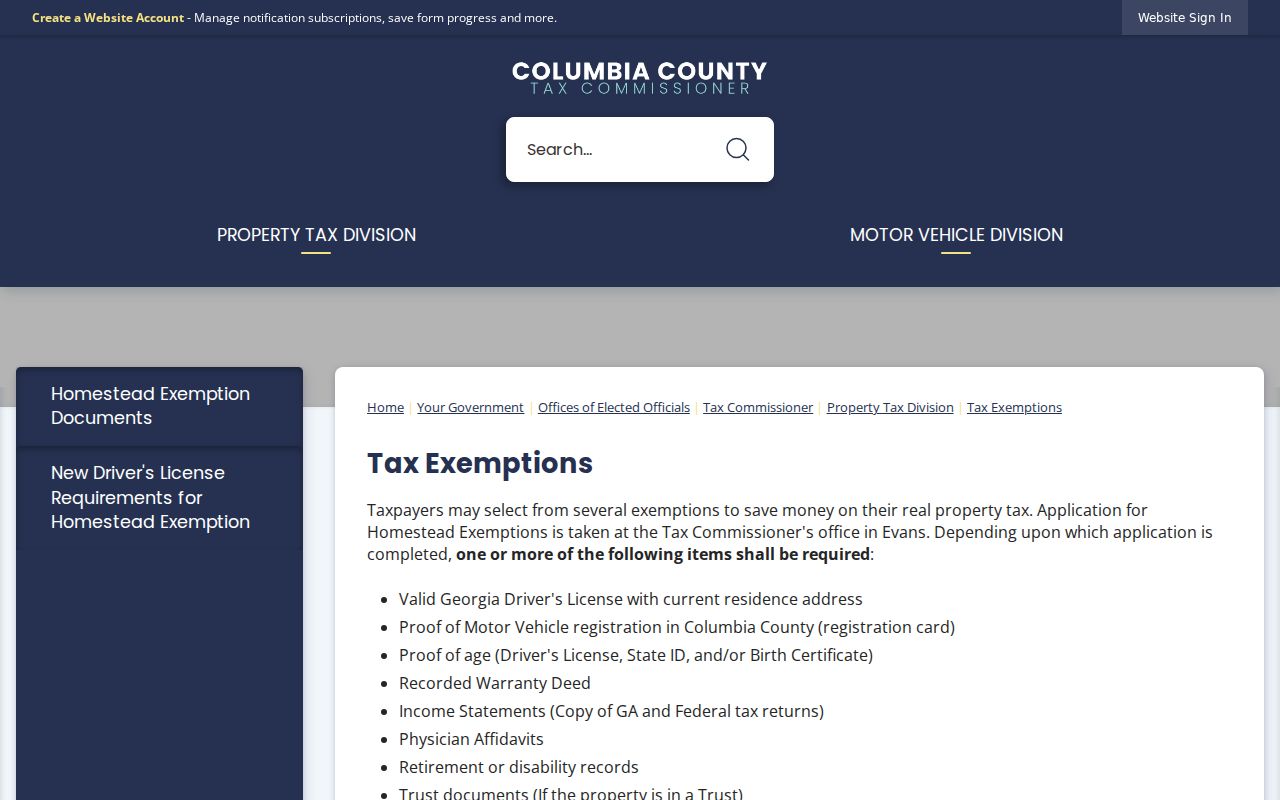
Keep the submitted form, proof documents, and decision notice filed with the parcel's annual tax record.
Columbia County Delinquent Tax Trail
The county's Delinquent Taxes page describes enforcement through levy and tax sale. The sheriff conducts a sale on the first Tuesday when one is scheduled. Notice runs in the Augusta Chronicle one month before the sale. No sale is promised every month. Preserve the tax year, amount owed, map-and-parcel, legal description, notice and sale dates, purchaser, deed details, and any redemption or release that follows. A tax-sale deed is not a warranty deed. Confirm the recorded instrument and any related court record before drawing title conclusions. The delinquent trail rewards careful documentation.
Columbia County Tax Data Limits
A tax bill does not establish market sale value. A digest does not prove who owns a parcel today. A GIS map does not fix a legal boundary. Each Columbia County property tax record has a narrow purpose. It serves you better when you preserve the record year and the office that keeps it. The county publishes no last-revaluation year and no fixed qPublic refresh interval. So do not infer either from one parcel result. For the value fields themselves, the Columbia County property value page explains the numbers without rebuilding the billing process. Context turns raw figures into usable answers.
Appeal a Columbia County Assessment
Columbia County lets owners challenge a value, a uniformity problem, taxability, or a denied homestead exemption through the county appeal process. The notice controls the clock. County materials describe a 45-day initial appeal period and 30-day deadlines at specified later stages. So read your notice. One deadline does not fit every case. Then choose a route, such as the Board of Equalization, a hearing officer where eligible, or arbitration. Submit parcel-specific evidence, whether comparable sales, photos, a survey, repair facts, or a clear account of the disputed characteristic. Superior Court rights hinge on the path and decision.
Appeal window. File by the deadline printed on the assessment notice. Columbia County materials use both 45-day and later 30-day stages.
Save the notice, form, evidence, proof of filing, and decision. An informal phone call never replaces a timely written appeal.
Georgia Rules Behind Columbia County Tax
State rules frame every Columbia County tax bill. The Georgia Department of Revenue property-tax source supplies statewide context for assessments and millage. Real property is generally valued at fair market value. Georgia then assesses it at the statutory 40 percent level, subject to exemptions and special assessment programs. The county builds its digest, and the taxing authorities and Tax Commissioner carry the process toward a bill.
Three numbers can differ without any error. Fair market value is the assessor's full-value estimate. Assessed value applies the state's 40 percent level. Taxable value subtracts exemptions or special treatment. Tax due follows once the relevant levies and other bill rules are applied. Knowing which number is which saves confusion.
Match each correction to the right office. Name the exact field and tax year. Do not say only that "the tax is wrong." Ownership mismatches point to the deed and assessor record. A payment issue belongs with the Tax Commissioner. A map or acreage problem may require GIS, a plat, or a survey. A valuation or uniformity dispute follows the formal assessment appeal path.
Keep a small audit set for each Columbia County property tax record. It should hold the dated parcel result, the annual assessment notice, and the exemption decision. Keep the bill, proof of payment, and any appeal order too. Do the figures conflict? Compare the tax year and parcel key first. A prior-year digest can be accurate for its published snapshot while a current bill or deed reflects a later event. This habit also keeps a tax-sale notice, a lien filing, and a final deed from collapsing into one date.
Property characteristics feed the valuation file. The Columbia County assessor says authorized staff may visit and update property records under Georgia law. Staff should carry official identification and use a marked vehicle. They may not inspect inside without owner consent. The visits concern assessment characteristics. They do not replace the deed record or put ownership changes on a fixed posting schedule.
Not every digest row, worksheet, or tax file appears online. Request the existing record in a usable form. Include the map-and-parcel, address, owner string, tax year, record type, and the exact fields sought. Columbia County states local copy charges can reach $0.10 per page. Significant administrative work is billed at the lowest-paid qualified full-time employee rate. Georgia's broader guidance allows reasonable search and retrieval charges and gives the first 15 minutes free. Ask for an estimate before costly work begins.
Recent county announcements may discuss long-term property-tax relief. That is not a parcel-level award. Use the current application, exemption decision, assessment notice, and bill for the subject land instead. Policy milestones and legislative proposals belong apart from the record that actually changes taxable value.